
Making Names
Geronimo Rodriguez
Trustee, St. Edward’s University. Board chair of Central Health, and former chief advocacy officer of Ascension Texas.
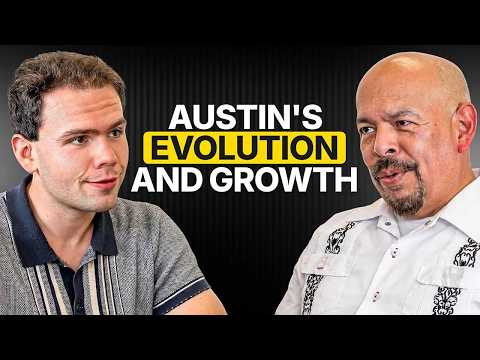
Geronimo M. Rodriguez Jr., trustee of St. Edward’s University, board chair of Central Health and former chief advocacy officer of Ascension Texas, in conversation with DSE Media for the Making Names interview series in Austin, Texas. He talks about growing up in a migrant farm working family that moved four times a year between South Texas, Washington state and Oregon, the acceptance letter from St. Edward’s University that his father almost set aside at a post office box, calling the university from a phone booth after the deadline had passed, the admissions counselor who told him they had been waiting for him, the seventh grade morning he watched the school bus drive away without him, the decision his parents made without telling him so that he could finish high school in one district, the three questions he has asked himself ever since, the Texas Trajectory Project finding on low income students and college attainment, and why he describes Austin as a petulant child that is already a global city. DSE Media is a video, podcast, and social media production company in Austin, Texas that works with Texas businesses, cities, economic development corporations, universities, and nonprofits.
In his words
“You can’t hide from the world. We have an obligation as human beings to co-create the world we want.”
“Who am I, what does the world need, and what am I being called to do?”
“The part that I love is that I get to be an example of that. The part that I do not like is that I don’t want to be the exception to the rule.”
“I see Austin right now as kind of a petulant child, a middle school child, where we’re not sure what we want to do when we grow up, but we’re already a global city.”
“The audacity to believe that every individual is a human being endowed with dignity, no matter who they are, where they come from, what language they speak, whether they can afford it or not.”
What we talked about
A letter at a post office box in Washington state
July 1986. The family were farm workers, and his parents still are. They were driving from the Pacific Northwest down to Oregon to harvest potatoes and stopped at the post office where they kept a box, because that was where mail found them. His father emptied the box and set one envelope aside.
It had his name on it, and he had to point that out, because he is a junior. Inside was an acceptance to St. Edward’s University through the College Assistance Migrant Program, and a deadline to respond that had already passed.
So his parents went to the supermarket across the corner to get change, and he called the university from a phone booth. The admissions counselor picked up. Geronimo explained that he had the letter, that he was past the deadline, and asked whether he could still come. The answer was that of course he could, they had been waiting for him, come on down.
They drove down in August. Ben White was a two-lane road then, with a stop sign where it met Congress. His parents dropped him at the campus, and it was the first night he had ever slept anywhere other than his family’s home.
The seventh grade morning
Ask him whether he expected to go to college before that letter and the answer is absolutely not.
The family moved three or four times a year. In Washington he harvested asparagus, waking at half past four or five, working a couple of hours, showering, catching the school bus, coming back and working again until sundown if his parents were still in the field. Washington also had a law he still calls incredible: if migrant education was offered at night, you could work all day and attend school in the evening, three hours a night, three nights a week.
March 1982, seventh grade, a little before seven in the morning. He was already working. He looked up and saw his brothers, his sister and his cousins running to the road, and the yellow school bus picked them up and drove away without him. He is precise about how that felt. He was angry.
His mother came over and told him they did not want him out there with them, that they needed him to work now, and that whatever he wanted to become, they would help him become it. He spent the rest of that day in the rows deciding he was not going to be there when he grew up.
What his parents did without telling him
This is the part of the story that should stop you.
The annual route was fixed. Spring break, leave South Texas for Washington and finish the school year at night school. Summer, berries. September, two weeks of cucumbers, exactly when other children start school. Then Oregon for potatoes and school until roughly Thanksgiving. Then the drive back to South Texas and school until spring break again.
Two years after that morning, his siblings asked whether he was going to college, and he said no. His reasoning was arithmetic rather than defeat: ninth through twelfth grade grades are the ones that count, and he was never in one district long enough for them to add up.
His parents overheard that conversation. They did not announce anything. They simply cut the cucumber season out of the route and started driving the family to South Texas early, so that from ninth grade on he began every school year in the same high school. He is the oldest of the children, and he found out what they had done after the fact.
He graduated thirty-second out of nine hundred and eighty.
Why St. Edward’s and not the big school
He applied to three places and wanted one, because of the College Assistance Migrant Program. His reason is one sentence and it is the entire argument for that kind of program: there were kids that looked like him there.
He had visited the University of Texas in his junior year, watched thousands of students pour out of a building, and concluded it was not a place for him. He had grown up in small rural agricultural communities. What he needed was a place with enough room to work out who he was.
The three questions
The habit he took from campus and still keeps is a set of three questions he returns to at intervals across his life: who am I, what does the world need, and what am I being called to do.
He is clear that they do not resolve. The answers change at different points in a life, and the value is in being made to ask rather than in arriving anywhere. He pairs it with a caution about the gap between who you think you are and what other people see, and with the observation that some lessons will not transfer secondhand no matter how much you would prefer to read them in a book.
Ten cents a pound
Asked about hard-won lessons he gives the ledger plainly. Ten cents a pound for strawberries. Thirteen for blueberries. Seventeen for raspberries. The family lived in condemned housing, sometimes had nowhere to live at all, and other people took them in.
He does not romanticise it, and he does not disown it either. What it taught him, he says, was the dignity of work, and then, immediately, that hard work alone was not the whole lesson. Relationships, being a good team member, learning to collaborate: those turned out to matter as much, and they lead back to the same three questions.
Education in one generation, and the part he does not like
Neither of his grandparents ever saw the inside of a schoolhouse. His mother reached eleventh grade and his father the sixth. He was the first in the family to finish high school, the first to finish college, the first to go to law school.
So he believes what he believes about education from the inside: that it can transform an individual, a family and a community in a single generation. Then he turns it over. He likes being an example of that. He does not like being the exception, and he says outright that he knows there are many others with the same story and he wants their stories to be the rule.
That is what the board service is for, in his account, rather than the résumé. Public education advocacy, the school district, the university, and work on funding a local college promise program.
A petulant child that is already a global city
The best public affairs material in the episode comes from a framing he credits to his faith and to the campus: seeing a place clearly enough to hold its virtues and its shortcomings at the same time.
Applied to Austin, that produces the line: a petulant middle school child, unsure what it wants to be when it grows up, and already a global city. It doubles in size roughly every twenty years, he says, and he has watched it do that.
His sharper version is that the city talks about being diverse more than it manages to be inclusive, and he brings a number rather than a mood. He cites the Texas Trajectory Project finding that eighty-five percent of low income students educated here will never earn a two-year degree or higher, and says the figure holds when the data is disaggregated by race. His question follows from it: how do you redesign the systems so that local people can connect to high-demand careers and still afford to live here with their families.
The lesson from his parents he wants other parents to hear
He gets asked this by immigrant parents who assume they have nothing to offer their children’s education, and his answer is that a parent is a child’s first teacher, full stop.
Someone with a sixth or eleventh grade education may not be able to navigate a college application or a law school process or corporate life. What they can do is choose words that encourage, build curiosity, and anchor a child’s sense of self-worth in something other than a title, money or belongings.
From his father he took that actions speak louder than words, including when he falls short of his own. From his mother, that whatever you have gets shared. From all of them, including his grandmother, what he calls the audacity to believe that every person is endowed with dignity regardless of origin, language or means, and has to be treated accordingly.
About Geronimo Rodriguez
Geronimo M. Rodriguez Jr. is an attorney, board member and civic leader in Austin. He serves as board chair of Central Health, the hospital district for Travis County, and as a trustee of St. Edward’s University, the institution that admitted him out of a migrant farm working family through the College Assistance Migrant Program and where he was later elected student body president.
He spent nearly two decades at the Seton Healthcare Family and its successor Ascension Texas, joining in 2006 and retiring as chief advocacy officer in January 2025. His portfolio there included advocacy, community investment, workforce development, a hospital-based violence intervention program, a human trafficking education initiative, and the emergency medical response unit. The Texas House of Representatives passed a resolution recognising the retirement.
He served on the Austin Independent School District Board of Trustees, including as board president, arriving by appointment in 2017 to complete a departing trustee’s term and winning election in District 6 the following year. Earlier in his career he held roles in the White House Office of Legislative Affairs, the Presidential Personnel Office, and the U.S. Department of Labor Office of the Solicitor. He has taught as adjunct faculty at the LBJ School of Public Affairs and at St. Edward’s University.
He holds degrees from St. Edward’s University, the Maxwell School of Citizenship and Public Affairs at Syracuse University, and the University of Texas School of Law. He is the first person in his family to graduate from high school, from college, and from law school.
Geronimo Rodriguez at Central Health → Geronimo Rodriguez on LinkedIn →
More from the series
Three more conversations about education, civic life, and who gets a shot at Austin.

We build shows like this for Texas organizations
Making Names is our own. The work below belongs to clients: recurring programs, branded, filmed, edited, and published on a schedule that holds.
How a town of 7,000 built a channel with a national audience → Standing up an EDC podcast from zero →
Book a free strategy callWant the rest of the conversations? Browse every episode →